Mario Before He Was Super
Everyone knows where Mario ends up. A castle, a flag, a princess in another one. What gets forgotten is that he spent four years in arcades first, and that he arrived at Super Mario Bros. one job, one name and one idea at a time. Three machines in the cabinet row here cover that stretch: Donkey Kong, Mario Bros. and VS. Super Mario Bros. Read left to right, they are a character being invented.
1981: a carpenter with no name
Donkey Kong exists because Nintendo had a warehouse of cabinets nobody wanted. A game called Radar Scope had flopped in America, and a young designer named Shigeru Miyamoto was handed the job of turning the unsold machines into something that would sell. He drew an ape, a girl and a small man in overalls.
The small man was not called Mario yet. He was simply Jumpman, and he was a carpenter, which is why the first stage is a building site. The overalls, the cap and the mustache were not character design so much as problem solving: on a sprite that small, a cap is easier to draw than hair, a mustache is easier than a mouth, and overalls let you see the arms move.
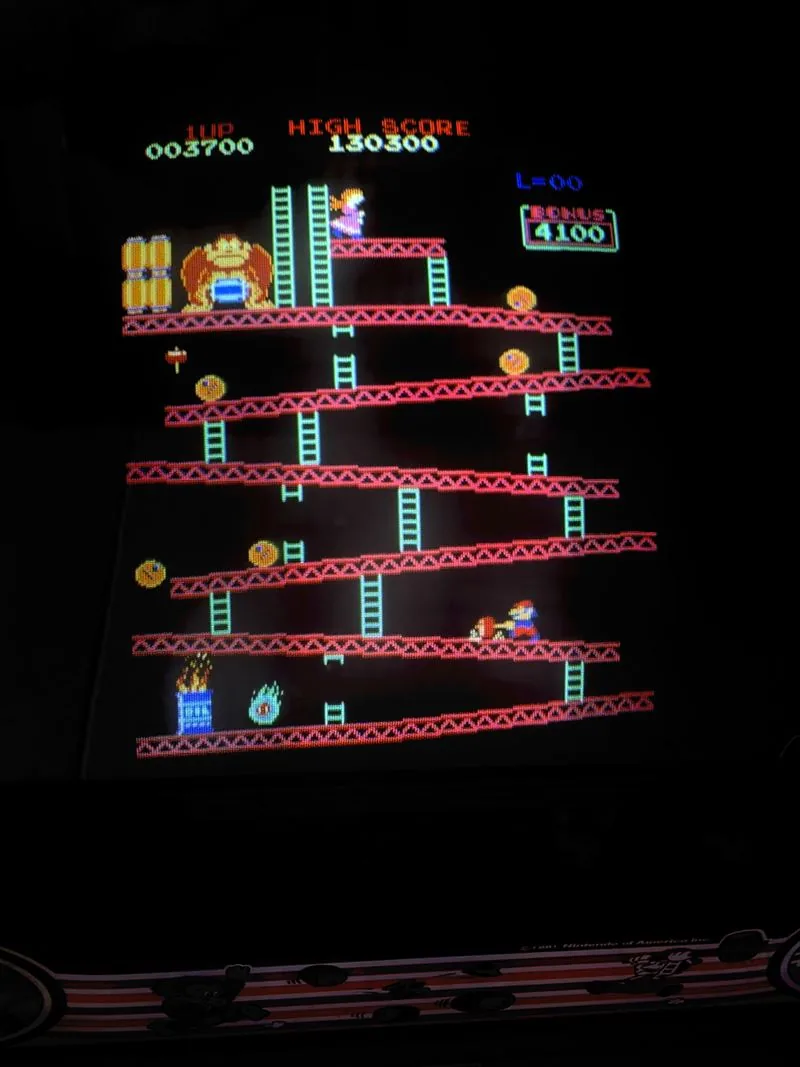
Play it now and the surprise is how fragile he is. Jumpman can clear a barrel and not much else. Fall the height of one girder and he dies. The jump is purely a way to avoid things.
In Donkey Kong, the jump is purely a way to avoid things.
The cabinet here also plays both sequels, Donkey Kong Jr. and Donkey Kong 3, without swapping a board. They are worth a detour. Donkey Kong Jr. is the game that first put the name “Mario” on him, and the only one where he is the villain. Donkey Kong 3 does not have him in it at all.
1983: a plumber, and a brother
Mario Bros. is where the rest of him shows up. The setting moves underground, so the carpenter becomes a plumber. A second player needs a character, so he gets a brother, and Luigi appears for the first time as the same sprite in different colors. The enemies are turtles, which will turn out to be important.
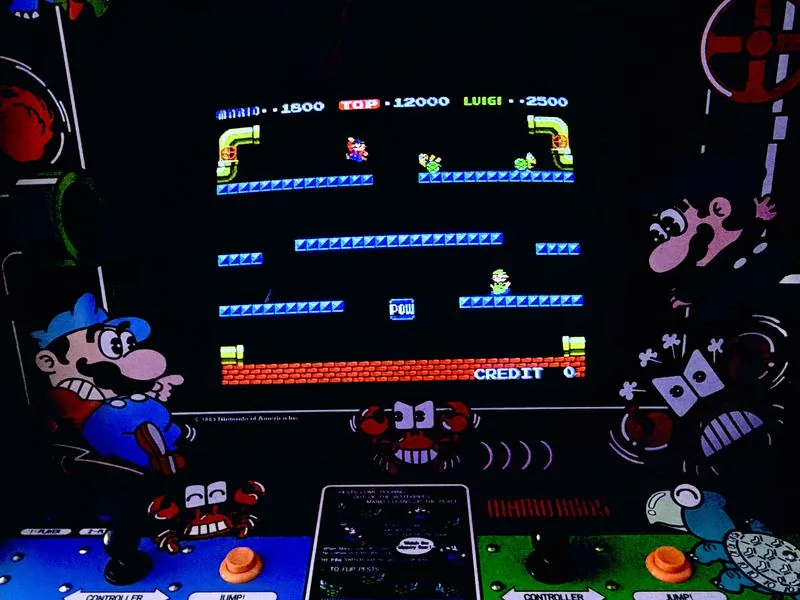
It is also where the jump starts to do something. You still cannot land on an enemy; touch a Shellcreeper from above and you lose a life. Instead you punch the floor from underneath to flip it on its back, then run up and kick it away. The jump has become a weapon, just an indirect one. And he can now fall any distance without a scratch.
The widebody cabinet makes the other point for itself. This is a two-player game on one wide panel, and it is nominally cooperative. Anyone who has played it knows what actually happens.
1985: the missing step
The next machine in the story is not an arcade game at all. Super Mario Bros. came out for the Famicom in 1985 and reached American living rooms with the NES. It took the turtles, the pipes, the coins and the brother from Mario Bros., pointed the whole thing sideways, and finally let Mario do the obvious thing: jump on an enemy’s head.
That one change is the difference between the arcade Mario and the Mario everyone knows.
1986: back to the arcade
Which brings the row to its third cabinet. VS. Super Mario Bros. is the home game sent back to the arcade a year later, on Nintendo’s VS. System hardware, and quietly rebuilt to be harder. That story has its own page: The Hardest Super Mario Bros. Most People Never Noticed.
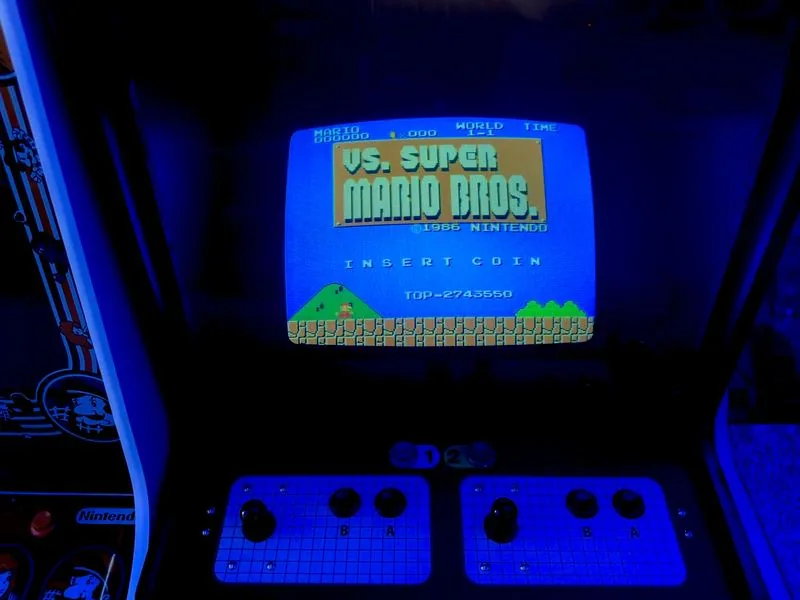
For this one, the point is simpler. Donkey Kong, Mario Bros. and the UniSystem sit side by side, and read in that order they are one story. A nameless carpenter who dies from a short fall becomes a named plumber who fights from underneath, and then the character who lands on things. It took Nintendo four years and three cabinets.
Quick answers
Was Mario originally called Jumpman?
Yes. In Donkey Kong (1981) the character was Jumpman, a carpenter. The name Mario first appears with Donkey Kong Jr. in 1982.
When did Mario become a plumber?
In Mario Bros. (1983). The game is set in the sewers, so the carpenter of Donkey Kong became a plumber.
What was Luigi’s first game?
Mario Bros. (1983), as the second player’s character.
Could Mario stomp enemies in the arcade games?
Not in Donkey Kong or Mario Bros. In Mario Bros. you hit the floor from below to flip an enemy, then kick it. Jumping on enemies arrived with Super Mario Bros. in 1985.
Has Mario ever been the villain?
Once: in Donkey Kong Jr. (1982) he is the one holding Donkey Kong captive.
Sources & further reading: Museum of the Game — Donkey Kong · Museum of the Game — Mario Bros. · Super Mario Wiki
← More stories The hardest Super Mario Bros. → The cabinet row →