The Best Screen for Retro Games
Was Never Sold to Gamers
The monitors in this collection weren't made for living rooms. They were made for broadcast engineers — and that's exactly why retro games have never looked better on anything else.
While consumers were buying Trinitrons at the mall, Sony was quietly selling a different class of CRT out the back door — professional monitors, built for television studios, edit bays, and master control rooms, at prices that would have made a Best Buy shopper faint. They came in two main families, and the letters on the badge tell you everything: PVM, the Professional Video Monitor, and BVM, the Broadcast Video Monitor.
The PVM was the workhorse. Studios used them for previewing feeds, hospitals wired them to imaging equipment, security desks stacked them in walls. Compared to a consumer TV, a PVM has a finer aperture grille, far higher line resolution, and — the part that matters most to game collectors — direct RGB input. A consumer TV of the era took a composite signal, a single muddy wire where the colors have already been smeared together. A PVM takes red, green, and blue as separate signals, straight from the console's video chip, nothing lost in translation. Plug a Genesis or a Super Nintendo into one over RGB and the image snaps into focus like someone cleaned a window you didn't know was dirty.
The BVM was something else entirely: Sony's reference grade, the monitors broadcast engineers used to judge whether the picture itself was correct. Hand-selected tubes, modular input cards (the BKM cards hunted on the wanted list), calibration controls deep enough to get lost in, and new prices that ran well into five figures — for a monitor a viewer at home would never see. A BVM doesn't try to make the picture pretty. It shows you the truth, scanline by scanline. For pixel art drawn by hand in the '80s and '90s, the truth turns out to be gorgeous.
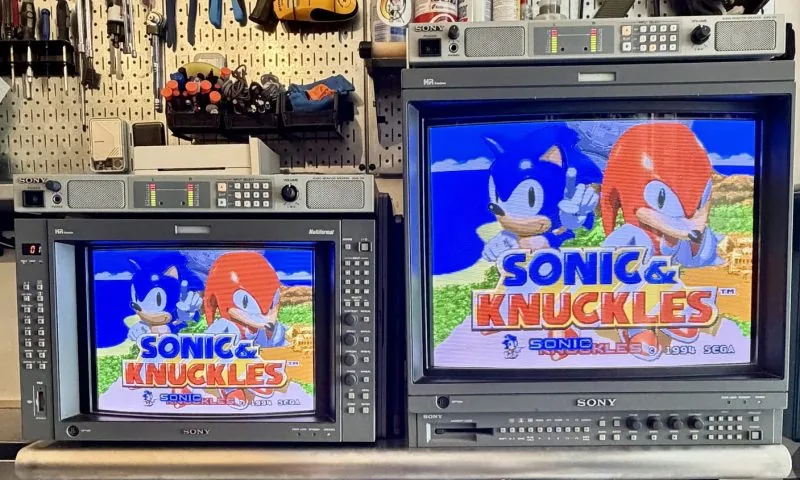
The fleet here — thirteen units across eight models, documented in Trinitron Fleet, Vol. 1 — grew out of a single purchase more than a decade ago: a 13-inch PVM-1354Q. One good monitor is a slippery slope; that first PVM has since moved on, the way first monitors do, but it opened the door to everything on the Monitor Fleet page.
Asked to pick just one to recommend today, the answer from this garage is the PVM-20L5 — a late-generation 20-inch multiformat unit that handles nearly anything you feed it, big enough to matter, versatile enough to be the only monitor you need. The sentimental pick is different: the PVM-2950Q, the 29-inch cube in the game room. It's an unreasonable object — enormous, heavy, shaped like a monolith — and Super Mario Bros. on that much curved glass is a religious experience. Versatility is a reason to buy a monitor. The 2950Q is a reason to keep one.
Sitting on professional Sony gear you don't want to freight across the country? The arcade buys — and when the fleet consolidates, departures land on the For Sale page. Email orlandusarcade@gmail.com.