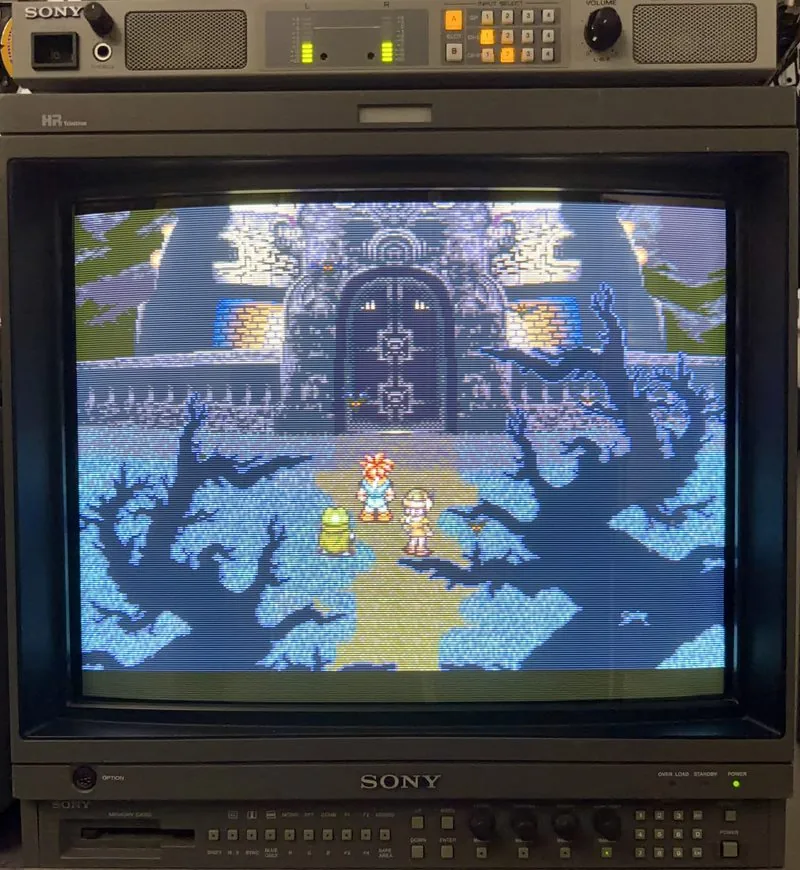
Sony BVM-20E1U
The grail. One thousand TV lines at twenty inches in 4:3 — a number Sony hit once, on this chassis, and never again.
Every collector has one machine that justifies the whole pursuit. This is that machine. One thousand TVL, at twenty inches, in 4:3 — a number Sony hit exactly once, on exactly this chassis, and never again. A grail earns the name on a single specification.
Inside is the M49LCB22X, an aperture grille so fine — roughly a quarter of a millimeter — that even the tube in its celebrated successor is coarser. This is the sharpest large-format 4:3 glass ever to leave the company, built in an era when a master control room would clear its budget for the reference seat. Today that reference seat belongs to something better: games.
Because here is the beautiful part — it is a standard-definition instrument by design. 240p and 480i are not formats it tolerates; they are what it is for. Feed it a Saturn or a Neo Geo and the scanline definition is as sharp as the format has ever been rendered, anywhere, by anything. This is the definitive large-format 240p display, and there is no asterisk on that sentence.
It is also a machine you get to build. Four option slots wait behind the fixed RGB block, and the full E/F card family runs to eight — a whole deck of possibilities. Composite is covered; the S-Video path is an open hunt running through a BKM-24N or 27T, tracked across two continents through auction alerts and a contact in Yamagata. Half the joy of a flagship is finishing it.
Sightings are rare enough to count as events. A sound example surfaces perhaps once a season, then vanishes into someone's climate-controlled bay — which is what grail tier actually means: not extravagance, but patience. This one's patience traces to October 1998 build stock, still holding a picture with no living rival.
Strictly SD forever. That is not the compromise — it is the specification.
Inputs, formats, and what it takes
- Formats
- 240p, 480i, 576i only — strictly SD by design
- Sync
- 15 kHz only
- Composite
- Via E/F BKM decoder boards — owned BKM-21D covers it
- Y/C
- Via BKM-24N or BKM-27T (on the hunt list)
- RGB / component
- 1 fixed RGB/component + slots (fixed input block with loop-through)
- SD-SDI
- Optional (BKM-20D/21D — both owned)
- HD-SDI
- None
- Option slots
- 4 + fixed RGB input — full E/F 8-card family
- Control
- Built-in panel; IC memory card; ISR/RS-485; optional BKM-10R remote
- Weight
- ~85 lb est. (spec unverified)
Work log
What has been done to it since it arrived.
- BKM-21D SDI multi decoder installed — SDI 4:2:2 and 4fsc in and out, plus analog composite, in one of the four option slots.
- BKM-20D on the shelf — The second SDI decoder, owned and ready; the hunt for the E/F-series decoder cards continues on the wanted list.
Sony BVM
HR Trinitron CRT (E-grade tube)
1995–2002
Native scan — the definitive large-format 240p display; razor scanline definition at 1000 TVL
Flagship
The SD reference of the fleet, and the sole E/F-series chassis here.
The open slots are the inputs. Which cards it takes, what each one does, and which ones are still being hunted is on the wanted list; the bench notes are on Projects.
The long-form feature, the full 28-line spec sheet and its sources are in Trinitron Fleet, Vol. 1; the side-by-side of every model is on the fleet page. Vocabulary — TVL, multiscan, BKM, loop-through — is in the glossary.