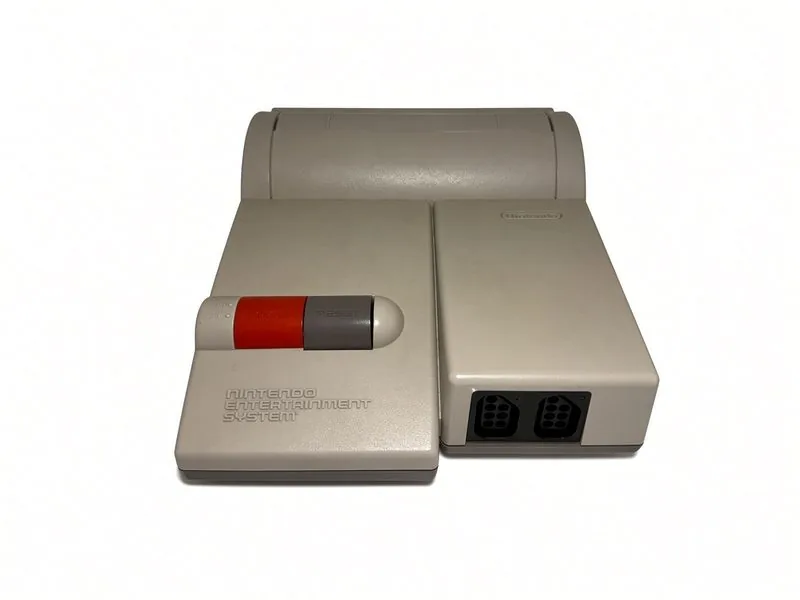
NES — Top Loader
Nintendo’s 1993 redesign of the NES. Out of the box it only spoke RF; this one puts out RGB.
Nintendo sold the top loader at the very end of the NES’s run: a smaller, cheaper box with the cartridge going straight down, the way the Famicom always had it. It dropped the front loader’s spring-loaded tray and the lockout chip along with it, so the blinking-screen ritual of the original console never happens here.
It also dropped the front loader’s AV jacks. Stock, the top loader speaks RF only, the weakest picture the NES ever had.
The NESRGB board fixes that at the source. It takes the color straight from the console’s picture chip, so this NES joins the rest of the shelf in RGB: an RGB SCART cable into the switcher, a SCART to 4 BNC breakout out of it, and a Sony monitor at the end.
What it puts out, and how it gets to the glass
- Stock output
- RF only
- Modification
- NESRGB board
- Video out
- RGB over SCART
- Into the chain
- RGB SCART → switcher → breakout → PVM / BVM
- Lockout chip
- None — removed by Nintendo in this revision
- Cartridges
- Top-loading, 72-pin, NTSC
Work log
What has been done to it.
- NESRGB board installed — RGB taken from the picture chip itself, ahead of any RF or composite stage.
- Family
- Nintendo NES — 8-bit, 1985 in North America
- Revision
- NES-101 — 1993, the top-loading redesign
- Status
- In service — On the display shelf, wired into the RGB chain.
The console mod table lists every machine’s path to the monitors, and The Signal Chain walks it box by box. The NES Front Loader carries an NESRGB board too; it isn’t on the display shelf. Nintendo’s own Player’s Guides have a shelf of their own, and the arcade side of the NES library is on the PlayChoice-10 wall.