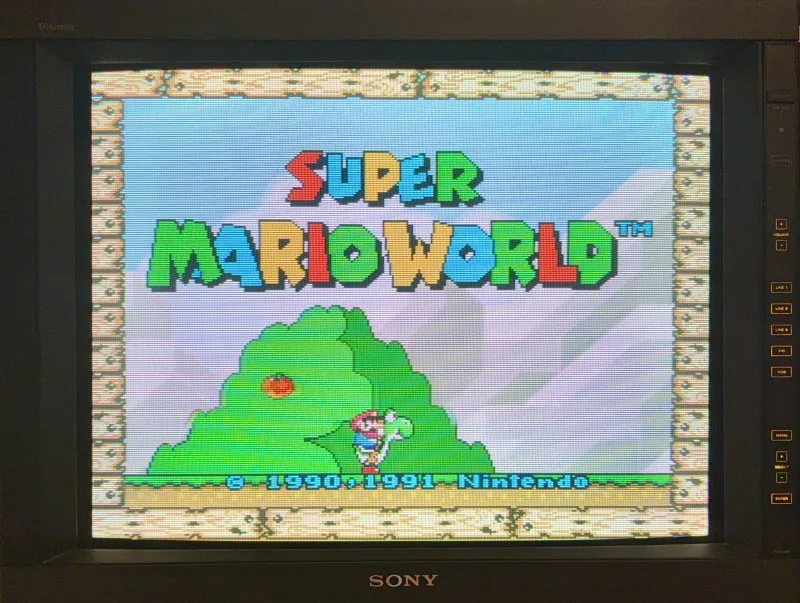
Sony PVM-2950Q
The cube. Twenty-nine inches of Super Trinitron, 115 pounds, and the biggest tube Sony ever put in a production monitor.
Every collection has a centerpiece, and this one announces itself before it is ever switched on. The PVM-2950Q is twenty-nine inches of Super Trinitron in a hundred-and-fifteen-pound cube — the biggest tube Sony ever committed to a production monitor, and the closest thing the format has to a monument.
Turn it on and the monument becomes a window. This is arcade-era spectacle at living-room scale: the same glass family the era's games were mastered against, blown up until sprites carry real physical weight. At 600 TVL the scanlines land soft and warm rather than surgical, and across a 27-inch face that is not a limitation — it is the original artistic intent, projected at full size.
Sit a 16-bit console in front of it and the effect is immediate. Color snaps. Blacks fall away to nothing. Motion arrives with zero apology. NTSC, PAL, SECAM — it auto-detects and simply gets on with the job, the way broadcast hardware always did, no menus to negotiate and nothing to configure.
And here is the quietly great part: beneath the brute scale sits the most serviceable big CRT Sony ever made. Convergence and geometry live in a digital service menu — the finest implementation in the PVM class — so keeping the picture perfect decades on is a menu exercise rather than folklore. Machines this size usually demand rituals. This one just asks for a shelf strong enough to hold it.
Arcade-era spectacle at living-room scale — a monument that doubles as a window.
Inputs, formats, and what it takes
- Formats
- NTSC / PAL / SECAM / NTSC 4.43, auto-select
- Sync
- 15 kHz only
- Composite
- 2× with loop-through
- Y/C
- Yes
- RGB / component
- RGB (BNC)
- SD-SDI
- None
- HD-SDI
- None
- Option slots
- None — fixed inputs
- Control
- Front panel + OSD; full digital geometry/convergence in service menu
- Weight
- 115 lb (52 kg, Sony spec)
Work log
What has been done to it since it arrived.
- SS-X7A speakers fitted — Sony's own optional speaker pair for the 2950, hung on the cabinet the way the catalog showed them.
- Full calibration — Geometry and convergence walked through the digital service menu — no pots, no folklore.
- Family
- Sony PVM — Super Trinitron CRT
- Era
- 1991–1996 — Native scan, soft scanlines at 600 TVL
- Status
- In service — Lit and in use, the big-screen 240p display.
Quick answers
What is the Sony PVM-2950Q?
Sony's 29-inch Super Trinitron production monitor, built from 1991 to 1996: 600 TV lines on a 27-inch viewable face, 115 pounds, and the biggest tube Sony ever committed to a production monitor.
How heavy is a PVM-2950Q?
115 lb (52 kg) by Sony's own spec. Machines this size usually demand rituals; this one asks for a shelf strong enough to hold it.
What inputs does the PVM-2950Q have?
Two composite inputs with loop-through, Y/C, and RGB on BNCs. No option slot and no SDI — the inputs are fixed. It auto-selects NTSC, PAL, SECAM and NTSC 4.43, and it is 15 kHz only: standard definition by design.
Is the PVM-2950Q good for retro games?
It is the big-screen 240p display here. At 600 TVL the scanlines land soft and warm across the whole face, and a 16-bit console in front of it is the reason to own one. Geometry and convergence live in a digital service menu, so keeping the picture right decades on is a menu exercise rather than folklore.
More photos in the gallery → · Every PVM-2950Q in the registry →
The long-form feature, the full 28-line spec sheet and its sources are in Trinitron Fleet, Vol. 1; the side-by-side of every model is on the fleet page. Vocabulary — TVL, multiscan, BKM, loop-through — is in the glossary.